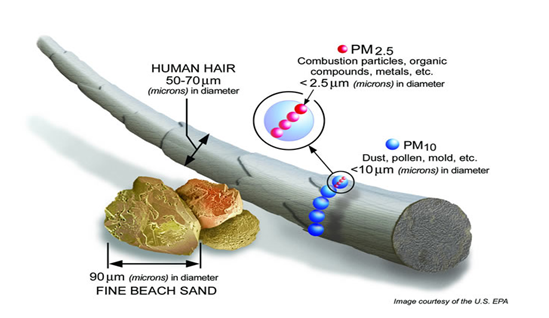
Particulate matter includes all solid and liquid particles floating around in the atmosphere. They can stay there from a few hours to months, depending on their properties and the meteorological conditions. A gas with floating particles in it is an aerosol. The behavior of particles in an aerosol is determined by the properties of the particles (dimensions, shape, density) and those of the gas (speed, turbulence, composition). To describe the behavior of particles, the concept of aerodynamic diameter has been introduced. This is determined by the size, shape and density of the particles. The aerodynamic diameter is defined as the diameter of a spherical particle with the density of water that exhibits the same behavior in the ambient air as the particle under consideration. PM 10is the particle fraction with an aerodynamic diameter smaller than 10 micrometers (μm), PM is 2.5 that with a diameter smaller than 2.5 μm. From a diameter of less than 0.1 µm (100 nanometers) it is referred to as ultra fine dust.
The particles can enter the atmosphere through a natural cause (natural aerosol) or through human activities (anthropogenic aerosol). In both cases they can be classified according to their mode of formation into primary and secondary particles. Primary particles are emitted directly into the atmosphere or are formed by mechanical comminution of coarser material (for example heavy metals in metal processing). The main human-caused emissions come from transport, industry, agriculture and building heating. Important natural sources of primary particulate matter are sea salt aerosols and blown soil dust. Secondary particles are formed in the atmosphere through oxidation and transformation from gaseous components such as NH 3 , SO 2 , NOx or from organic compounds such as volatile organic compounds (VOCs).
The composition of secondary particles is very complex. They are formed from the gas phase and on condensation, where the substances with the lowest vapor pressure condense faster than those with a higher vapor pressure. The fine particles can therefore have a complex, layered composition. This is reinforced because the available surface area of all dust in the atmosphere is mainly provided by the small particles. Substances that are emitted in gaseous form (including dioxins) will therefore almost exclusively be deposited on the small particles. Heavy metals from smelters and traffic, PAH, dioxin and soot are therefore contained in the fine fraction.
Epidemiological studies show that the main health effects of air pollution are due to particulate matter and to a lesser extent to ozone. Inhalation of fine dust causes irritation or damage to the lung tissue. Fine dust can have both short and long-term effects. According to the World Health Organization (WHO), there is no safe threshold value below which no adverse effects occur. With short exposure to particulate matter existing health problems such as respiratory infections and asthma become more serious, but the health effects of long-term or chronic exposure are considerably greater. Chronic exposure increases the risk of cardiovascular and lung diseases, as well as lung cancer.2.5 concentrations (Amann et al, 2005). In Flanders, particulate matter accounts for about three quarters of the healthy life years lost as a result of environmental factors (MIRA, 2012). The strongest link with health effects is found for the PM 2.5 fraction, but effects have also been demonstrated for the ultra-fine fraction (fine particles smaller than 0.1 μm) and the coarser 2.5-10 μm fraction (Brunekreef et al, 2005) . Particulate matter contains Black Carbon (BC or also diesel soot) and other combustion-related material, which in itself is not the most toxic component of the smaller PM particles, but is a carrier of all kinds of chemical toxic substances.
In addition, particulate matter also has negative effects on climate change and ecosystems. It contributes to the degradation of treated surfaces, which therefore require faster cleaning (the so-called soiling effect) and, depending on the composition, has a corrosive effect on materials and cultural heritage. Particulate matter has both a cooling (sulphate aerosols) and warming (Black Carbon) effect, and therefore also plays a role in the climate change problem.
Original text by Irceline , image from EPA